
Balance is a critical aspect for life as a bi-pedal individual. With the body being stacked on two feet, spatial awareness while controlling the body is a constant challenge. Aging does little to assuage the situation. Thus, making balance practice a priority will provide many benefits to the person.

Balance results from the coordinated interaction between several systems in the body. Neural connections for human balance involves the visual system, vestibular system (inner ear), and proprioception (muscles/joints). They send sensory input to the brainstem and cerebellum. The brainstem and cerebellum, acting as key receiving hubs, process the information and send signals to coordinate muscles and joints for postural adjustments. .

With age, for many in modern society, comes lack of activity. The resultant breakdown of connectivity between these systems can lead to (one) struggling with the basics of (even) walking. It is a good practice to have some type of balance format in place that can be practiced at least once a week.

There are many activities that can help one to improve balance. There are progressions and modifications available that can be applied based on individual abilities and goals. One need not stand on posts in crane stance, although that can be a goal. Bringing focus to alternatingly standing on one leg for ‘a time’ can, for many, be the beginning of improving balance. On the other extreme, there is standing in crane stance or in something similar.
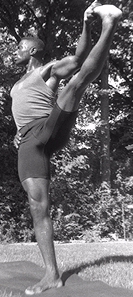
For instance within the context of a ‘yoga (asana)’ practice there is a pose called Uttihita Hasta Padangusthasana (Extended Hand-to-Big-Toe Pose)
Uttihita Hasta Padangusthasana (Extended Hand-to-Big-Toe Pose) is linked to improved neural connectivity and brain health, primarily through their demands on balance, focus, and core strength. It is a challenging pose but it is very beneficial.
Uttihita Hasta Padangusthasana specifically contributes to neural connectivity through several mechanisms:
- Balance and Coordination: This is a demanding balancing pose that requires intense focus and concentration. The act of balancing actively engages the brain’s cognitive and motor control centers, improving coordination and stimulating specific brain areas.
- Emotional Stability and Focus: By requiring a steady gaze (drishti) and core engagement, the pose activates brain areas that help in gaining emotional stability and improved focus.
- Proprioception: Maintaining stability in the pose enhances proprioception (the body’s awareness of its position in space), which strengthens neural pathways between the body and the brain.
- Nervous System Stimulation: The pose stimulates the spine and nerves of the legs and lower back, improving circulation to the nervous system.
- Myofascial, Sling Activation: refers to a given group of muscles, fascia, and ligaments functioning synergistically to create stability and mobility, maintain alignment and create efficient movement patterns
In essence, the pose acts as a form of “self-control training” for the brain, enhancing efficiency of the neural circuitry associated to attention, focus, and emotional regulation. All balance poses enhance coordinated neural activity. Working on developing and maintaining the ability to balance will stimulate complex brain functions (processing sensory information and coordinating movement) which is ultimately linked to good brain health.
Work on your balance. Work on your balance. Work on your balance.
 Ab-Sutra Wellness and Fitness