
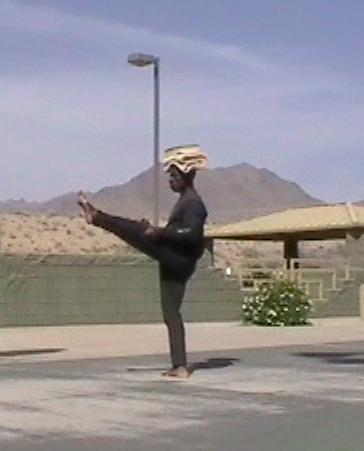
Developing physical aptitude requires the establishment of foundation enhancing, neural pathways, i. e. consistently practicing basics. An indispensable part of a martial arts discipline is that of repetition and application of basic techniques. The ‘breathtaking movements’ that many martial arts action stars perform do not occur ‘spur of the moment’. It is through regular reinforcing of neural circuitry, regularly, that actions are made to appear effortless. The individual with a better foundational base will typically be the victor in a real fighting situation. The importance of practicing basic technique cannot be overstated.

The beginning of learning any process is one step at a time; getting to anywhere requires a succession of consistent steps. An act as rudimentary as that of human walking can develop only through repetition. Some people seem to be ‘gifted’ in the executing of some actions. Yet, the norm is that ‘practice make perfect’, as the old adage states. The nervous system is like a series of relays. Repetition, via practice, facilitates neural adaptation essentially “rewiring” for better performance of the intended / desired specific actions. s ilitates . . . . and many still
Any display of, performance of, or execution of high level martial arts technique does not come about haphazardly. In martial arts, that is ‘any martial art’, there are phases of learning involved. The beginning is often times the most challenging phase of the process. Getting the steps correct is not so much the important part. The learning of the steps is what prepares the practitioner for achieving improvements in performance.

Regular, steady practice of basic technique reduces nerve impulse conduction time which facilitates automatic reaction / response and fluidity of execution. Kinesthetic awareness, body position(ing) and ‘speed of technique’ are key aspects for proficiency in a martial art. Continued practice helps in these areas by physically strengthening the neuronal interconnections within the brain. Intentions for specific actions travel along the improved neural pathways more efficiently, making them easier to recall and perform with greater fluency; i. e. speed. This can be termed: “cells that fire together, wire together.”.
Skill (repetition practice and speed of technique) will typically trump strength in a fight. unless that strength is In a fight between a “skilled fighter” and a “strong fighter,” generally, the skilled fighter would have a significant advantage, as proper technique and strategy can often overcome raw strength, especially if the skill gap is large enough; however, a very strong opponent could still pose a serious threat, particularly if they can land a powerful blow early in the fight. The stronger fighter would win between opponents of equal skill. The more skilled opponent would win between fighters of equal strength.

At the end of the day, one must establish a solid foundation of basics to achieve the capacity to powerfully and fluidly execute elementary and advanced technique. There is no magic elixir. There is no automatic invincible technique. There is only practice. Regular repetition of technique. There is no high degree of performance without a solid foundation of basics. “Before I learned the art, a punch was just a punch, and a kick, just a kick. After I learned the art, a punch was no longer a punch, a kick, no longer a kick. Now that I understand the art, a punch is just a punch and a kick is just a kick.” – Bruce Lee
The practicing of basics extends to all areas of proficiency in an activity:
Examples of specific techniques to practice depending on the activity:
- Running: Proper foot strike, posture, arm swing, cadence
- Swimming: Body position, arm stroke mechanics, leg kick
- Weightlifting: Correct lifting form, proper grip, controlled movement throughout the lift
- Yoga: Alignment in poses, breath control, transitions between postures
- Basketball: Dribbling technique, shooting form, defensive footwork
 Ab-Sutra Wellness and Fitness