
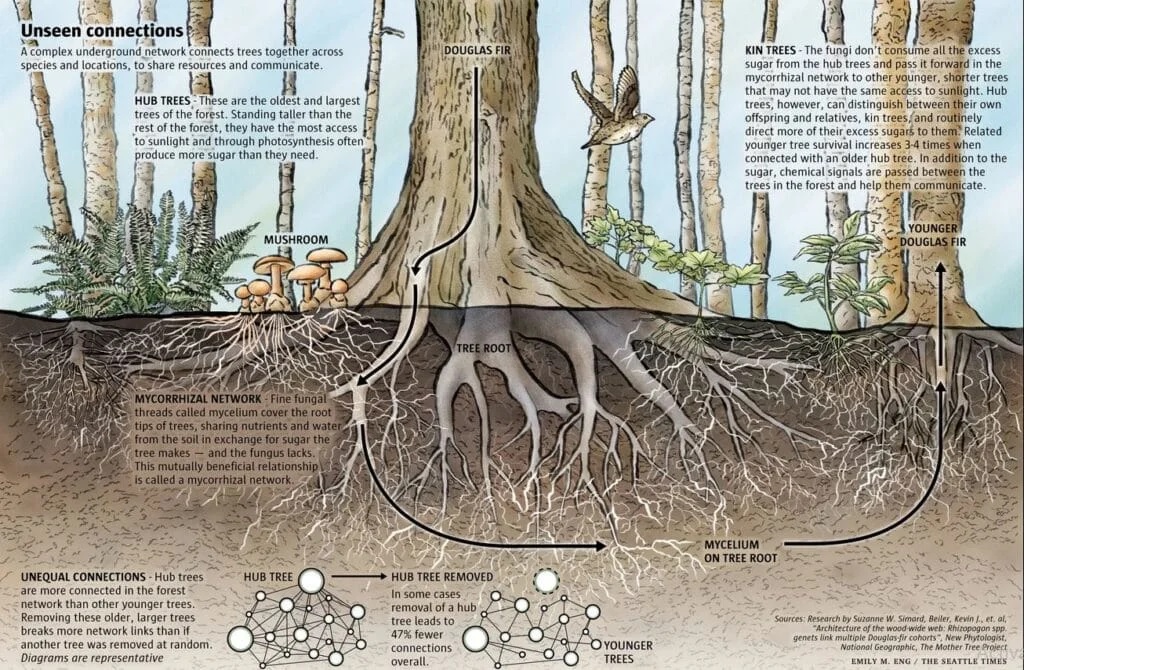
Tree roots intertwined with mycelium network1 2 3 4. The mycelium is a network of tiny fungal threads that wrap around or bore into tree roots, connecting individual plants together to transfer water, nitrogen, carbon, and other minerals2 4. This network, often referred to as the “Wood Wide Web,” allows trees to share resources and warn each other of potential threats1 3.
“Curse him, root and branch! Many of those trees were my friends, creatures I had known from nut and acorn; many had voices of their own that are lost forever now. And there is a waste of stump and bramble where once there were singing groves. I have been idle. I have let things slip. It must stop!” Saruman! A wizard should know better! [long loud yell] There is no curse in Elvish, Entish, or the tongues of men for this treachery. Treebeard – LORD of the Rings: The Two towers
Modernity provides for many options in society today. Shelters are permanent fixtures in the current landscape. There is access to groups of people, providing for more options to choose amongst those with whom one is most comfortable. Yet, modernity has done much to cause disruption and division. Division within society. Differences on views held, physical appearance, religio-spiritual choices, can be barriers to overcome. Division of communication networks inherent in nature. Continuity of ecological diversity is being disrupted in favor of economic gains fostered by monocultured landscapes. Division between society and nature. Humans, having historically functioned within the fabric of nature, continue to become more separated from nature, often viewing ‘it’ as a disposable inconvenience. consequently, people have lost their connectivity to nature and to each other.
The prevalence of technological prowess is the highlight of modern society. The developments that have propelled society forward are built upon previous discoveries. Some things that are created serve as the groundwork for subsequent spin-off creations; or, they lay the foundation for improvements upon the initial creation. This is to say that the benefits of technology are not stagnant. A device is constructed, it proliferates throughout society, it becomes a mainstay. People come to depend upon these creations. The contrivances of modernity have established an extensive link through the familiarity of usage. Humans become subconsciously bonded to these items. The commonality of technological proliferation is a far reaching phenomena throughout much of society
Home environments can be controlled for comfort to an astonishing degree. With the advent of IoT, communication with the home can facilitate acts that, in times past, would have required the presence of an actual human. Wireless communication can be an important for the experiencing of comfort. Living comfortably is a highpoint of existing. To have comfort on demand is liberating; albeit, distorted. Distorted in that outside of the context of modern society. this situation would not be possible. Communicating with and giving instructions to the home, from afar, is a situation that is reflective of ‘the society inhabited by the Jetsons’. This wireless aspect of interacting is far reaching, literally and figuratively. People can be halfway around the world and still interact with and send instructions to their home environments. Ways of communication and connecting in modern society are continually evolving.

People having similarities in interests, opinions and goals are easily accessible to each other due to technology. People often find community based upon what they like to do, upon those things from which they draw inspiration. Similarities allow for ease of communication, of relating, of interacting. Basically, “like attracts like”: People with similar traits, interests, or values tend to be drawn to each other. The familiarity which develops is a function of like-minded souls having been drawn together. This development can be loosely associated with the law of attraction. Communication between like minded individuals must take precedence for the maintaining of group cohesiveness
The prevalence of technology has done little to bridge the divides that exist throughout the world. There are cell phones in every hand. People can easily, effortlessly contact others on the other side of town, in another state, in a different country. Yet, the ability to connect does little to foster connection. More than ever, people feel feel as though they are adrift. An epidemic of increasing widespread of social isolation and loneliness is being experienced in modern society. The pervasiveness of the sensation of abandonment may be related to the loss of connection to nature as ‘the supporting foundation’ for life on earth.
Nature is consistently (being) parceled and disrupted in the pursuit of economic livelihood and stability. Nature is viewed with indifference. The land is parceled off in ways the disrupt ecological continuity. Speaking of communication, the forests are fairing poorly against the onslaught of economic predilection. Old forest have been sacrificed on the financial altars of corporate concupiscence. That trees communicate has been scientifically established. The intertwining of tree roots with mycelium creates a network that facilitates the transfer of water nitrogen, carbon and other minerals. This network, often referred to as the “Wood Wide Web,” allows trees to share resources and warn each other of potential threats1 3. Grasslands also communicate through root systems. This communication has been substantially upset due to practices associated with monoculture farming and overall economic pursuits.

Much of the modern populous has virtually no connection to or awareness of the ecological underpinnings from which they have arisen. Disrupting mycelial and tree root networks and grass root systems can have significant negative impacts on those ecosystems. These networks, crucial for nutrient and water exchange between plants, can be damaged by various human activities, including soil disturbance, chemical use, grassyland degradation and deforestation . Such disruptions can weaken individual plants, alter plant communities, and even affect resilience of forests and grassland. Progress has served as a source of disruption and destabilizing of the human psyche. The degree of ungroundedness that is rife throughout modern society might be alleviated by access and exposure to spaces that are ‘natural’. To quote Rev. Joseph H. Hilts “To hold converse with nature, tends to expand the intellect and quicken the sensibilities”1.
Mechanization not only hastens the destruction of nature. It also serves to sever the connection between the earth and humankind . . . . . . . .
1. Experiences of a Backwoods Preacher Rev. Joseph H. Hilts, Second Edition (1892) Chapter V
the prevalence of modern technology that
lling places gress

